Monday, 16 November 2015

If Austin Powers did interior design...

Sunset over the concrete jungle
Tallinn was our final stop before we embarked on our journey across Russia and we consciously tried to remember to appreciate where we were rather than get carried away with the next step of our trip.  During our stay however we had to do a little bit of preparation work for the Trans - Siberian Express.  It is surprising when you are travelling just how quickly time runs away and just how much planning has to go in to try and make the most of each place you visit.  Most evenings in Tallinn (as with a lot of our stops) we spent time sorting out visa documents, making sure accommodation was booked in the right area of each city and saving seemingly countless maps to try and make life as easy as possible.  We did this in an apartment that had been designed by Austin Powers and set in a concrete jungle of bleak Soviet high rise apartment blocks.  Our pad was complete with leopard print wall paper, bright floral bedding and photos of half naked tribal women - nice!   

View from the upper town
As it turned out we did not need to worry about getting ahead of ourselves.  The historic centre of Tallinn was for me (if not Hannah) as charming and picturesque an old town as I had seen on the trip. Intertwining cobbled streets, colourful medieval buildings and imposing town walls topped by ancient church spires that sprung out above the town roofs adorned the city centre.  Tallinn was a major part of the Hanseatic group of cities in medieval Europe and the town is still divided after the merchants and artisans built a wall circling the lower section to separate themselves from the noble.   The upper section of town provides great views across the centre and contains the magnificent Alexander Nevsky Orthodox Cathedral with huge golden domes that greet you as you enter through the town walls.  The lower town is a maze of narrow streets housing countless museums, coffee shops and bars. We spent one afternoon in the old town designing marzipan sculptures as Tallinn (as well as a host of other cities) claims to have discovered the famous sweet.  After a hard fought competition my former art teacher was proved right to grade my ability as no more than very poor for 9 successive report cards.   My ship was by far the worst creation in the room and apart from Hannah I was at least 25 years older than the other people playing with marzipan.

The marzipan sculptures
KGB espionage equipment
The most interesting part of our trip was visiting the Viru KGB Museum, housed in the only hotel that was allowed to accommodate western visitors from across the Iron Curtain during the Cold War. As such the KGB had an entire floor on the top of the hotel to monitor all of the guests in the hotel and follow them when they left.   After the collapse of the Soviet Union the KGB officers based in the hotel had left quickly, leaving behind their equipment including bugging devices, old cameras, exploding purses and their radio equipment.  There was even the laminated plan of the hotel restaurant marked with an X to indicate to the waiter which table to place the bread holder that contained a listening device in! The room had been left exactly as it had been found and it was a very cool insight into the espionage that took place, as well as offering amazing views across the city and Tallinn Bay.

After a prolonged shopping trip to buy a coat and a set of hand made woollen gloves that made my hands smell like a sheep’s arse we decided to test our clothes for Russia with a long walk.  We set off through Kadriorg Park, now unfortunately minus any leaves on the trees and continued on the 6 kilometre path that ran alongside the water front.  Although not the most picturesque walk of our trip with heavy industry and freight shipping lining the horizon we did at least establish we should be fine with anything the Russian winter could throw at us.  Waking up very excited the following morning the friendly owner of our apartment, Dimitri, gave us an Estonia fridge magnet (just what every backpacker wants to carry) and a lift to the bus station to begin our journey to Russia.

Saturday, 14 November 2015

The European Capital of Culture

The Central Market in Zeppelin hangers
We continued the journey north through the Baltic States into Latvia to spend some time exploring its capital, Riga.  Sitting at the crossroads of former great European powers and strategically situated for trade, Riga has been invaded by numerous rulers over the centuries.  Unsurprisingly, Latvia has a very dark history with the 1939 Molotov-Ribbentrop Pact initially seeing their fledgling independence (post WW1) signed away and the nation swallowed up by the Soviet Union.   Latvia then initially welcomed the Nazi’s with some believing they would restore independence before the Red Army finally retook the Baltic lands.  The Occupation Museum was a moving tribute to those that lost their lives under the regimes with harrowing videos of interviews from survivors describing their time in the gulags when the region underwent mass deportations during the Russification of the Baltic States. The guide on the walking tour commented that joining NATO and gaining the Euro were very important to Latvia’s future security with an unpredictable neighbour putting pressure on the region and with 25% of the total population remaining Russian.  Despite all this, two decades of independence seemed to have been well spent and the nation seemed intent on promoting Latvian culture and heritage.

The Old Town, Riga
When we arrived in Riga Hannah (at least I remember it this way) was disappointed to discover that we had just missed Baltic Beauty 2015 so we set out to find James Bond as a replacement. As well as finding a showing in English the cinema was also handing out free champagne, bonus!  After this success we were ready to explore the narrow cobbled streets of the city’s old town.  Although not as impressive as Prague or Krakow the small old town has been well restored following the Soviet destruction of the city in retaliation for resisting the Red Army following the Nazi retreat.   It won the 2014 European Capital of Culture and optimism from locals under a coalition led by the leftist Green Party gave the city a positive atmosphere despite the plunging temperatures.  Just outside the centre was a huge market set in five gigantic Zeppelin Hangers that sold everything from local handicrafts to smoked eel and herring and was a great way to spend a few hours in the afternoon.


The Baltic Riviera
The following day we headed out of the city towards the Baltic's equivalent of the French Riviera and the town of Jūrmala, a short train journey away.  We arrived at the station with 3 minutes to run the length of the platform and our initial euphoria at getting on in time was quickly replaced by concern when a passenger informed us we were on the wrong train.  At that very moment the doors shut without warning and we set off in to the unknown.  Wearing a face akin to somebody that has just shit themselves in public Hannah began to panic but with detective work Sherlock Holmes would be proud of I looked at the other passenger’s attire and luggage and deduced we were on a local train rather than a long journey out of the city and sat down.     As it turned out the passenger had not understood our pronunciation of Latvian towns correctly (Jūrmala = yoor-muh-lah).   Jūrmala, is full of Russian oligarchs and subsequently it is full of shops selling the most garish fur coats. Huge new properties are sat back from the beach and so the waterfront is relatively unspoilt despite the investment.  Mixed in with the modern buildings are traditional wooden houses that look like something out of a fairy tale with bright colours and high spires adorning the individual designs.  After a long walk along the pristine beach in the sunshine we headed back to the city for our last night in Latvia before continuing our Baltic adventure in Estonia.

Tuesday, 10 November 2015

The Magnificent Arse End of Nowhere

The arse end of nowhere
With stage three man flu developing our trip to the Baltic Sea was a good tonic to my illness and we spent a few days enjoying the fresh sea air and breath taking walks along the Curoniun Spit.  The Curoniun Spit is a 98 km long sand dune peninsula which dates back to prehistoric times and is now covered almost entirely in pine forest.   Today, Lithuania shares the spit with the Russian-controlled Kaliningrad Region (I never knew Russia still had a region outside of its main borders in Europe).  Now a UNESCO site it is a constant battle to preserve the spit as it is threatened by the natural forces of wind and waves, as well as tourism. Numerous conservation projects are currently active and there are now established walks and cycle paths through the dunes that are closely monitored to ensure tourists are not entering the protected areas.  We stayed in the village of Nida, the metropolis of the spit home to around  1500 residents although a lot of these are only around in the summer tourist season.  We therefore entered a ghost town with very little open in the village but still managing to catch the last of the autumnal weather and forests. 

The village of  Juodkrantė 
The Witches Trail
Although based in Nida we caught the bus on our first morning up to the town of Juodkrantė on a quest to find the wild elk that roam the national park.  Described as being in the slow lane even in the summer season Juodkrantė appeared to have pulled over on to the hard shoulder and hibernated in the winter months.  Seeing around 8 people all day and with no café open in the whole town lunch was spent on a bench with a veritable feast consisting of a banana and half a Lion bar but at least there was a coffee machine outside the shop to warm us up.  We headed off for a walk through the forests on Witches’ Hill where a collection of devils, witches and other fantastical and grotesque wooden carvings from Lithuanian folklore lurk along a trail.  After a few hours walking in the deserted pine forest with no joy on my hunt we stumbled upon the beach on the far side of the spit.  Coming from the north of England most of my beach time is spent on wild dunes in the cold but here we really had discovered the definition of being in the arse end of nowhere.    Looking along the desolate dunes onto the Baltic Sea with a low, black sky seemingly encasing us we felt like we were at the ends of the earth.  We walked back through the forest to the lagoon side of the spit to catch the bus home and just when I though my search for an elk had ended in disappointment we walked past a garden with a giant elk sat watching us whilst chomping on the grass.  Whether this counts or not as wild is open for discussion but as it was undoubtedly an elk we caught the bus back to Nida happy that we had fulfilled our quest.


The foot path - or lack of
The weather was living up to it's reputation but despite the Baltic temperatures, wind and rain we explored the sand dunes around Nida the following day.  At the top of the 52 metre sand dune west of the town we were able to look out across the split and take in the forest, sand dunes and the water on either side of the spit.  It was an incredible panoramic with the lack of any human interference making the baron wilderness seem even more imposing.    We continued our walk on a path that was supposedly impossible to get lost on but we somehow ended up in the middle of the wilderness (thanks tourist information) with a maze of different ‘paths’ going in all directions.  Eventually we found our way back to the town and sheltering from the elements enjoyed the local delicacy – raw salted herring and potatoes – before catching the evening bus back to Klaipeda on the main land.  Driving in to the city we passed the Russian Embassy where hundreds of bouquets of flowers, candles and messages of condolence had been lain outside of the gates in remembrance of the victims of the plane crash over Egypt.  Klaipeda was our final stop in Lithuania before heading north and I left feeling that it had been one of my favourite nations we had visited on our trip through Europe, with its quirky culture and eclectic scenery making it one of Europe’s best known secrets.

Looking across towards Russia

Friday, 6 November 2015

Vilnius Uncovered - Water to Beer and a Tank Driving Mayor!!!

Knowing nothing about this seemingly forgotten country when we arrived Lithuania turned out to be a small but captivating nation and one that grew on us both the longer we stayed.   I was keen to learn some facts about it and some of the more quirky discoveries included:

  •  Lithuania was the first nation to announce its independence from the Soviet Union.
  •  ‘The Baltic Way’ was a peaceful protest against communism when 2 million people from Vilnius to Tallinn held hands and stretched 600 km across the Baltic states!
  •   It has the oldest living European language and is connected with Sanskrit
  •  Everyone was given a free woollen t-shirt to convert from Paganism to Christianity, a lot of people converted regularly in the winter months.
  •  It used to be the biggest nation in Europe in the 1400’s before being carved up by surrounding European powers.
The centre of Vilnius
We had planned on visiting a few places in Lithuania, starting in the capital, Vilnius, before heading towards the Baltic Sea.  Vilnius was a very green city and although small (unsurprisingly for a country of just 3 million people) it had an attractive old town and it turned out to be one of the most eccentric cities we have explored. The baroque style old town is a UNESCO heritage site and with its cobbled roads, hill top views and its own breakaway state all within the city limits it proved to be an engaging start to our visit to Lithuania.  We ended up staying in a beautiful hostel called the Downtown Forest Hostel and with Dylan playing when we arrived and free coffee it provided a perfect base to explore the surrounding areas.  Winter days in Vilnius are short and the afternoons quickly fall away into darkness into an all-consuming cold so most of our exploring was done before 4 o’clock (although the city is beautifully lit up at night).   Unfortunately we arrived on a bank holiday and as the museums were shut Monday and Tuesday we decided to venture to a small village close to the city for a day trip.    Exploring the city with a local we learnt that Vilnius was not the straight laced city it appeared and that the President was not to be messed with as she holds a black belt in karate.  One former mayor of the city won an Ig Noble prize, a parody of the noble prize which aims to honour achievements that at first make people laugh and then make them think.  Annoyed at the continued abuse of the cities bike lanes HE DROVE A TANK over the top of a car parked in a bike path leading to numerous cars in the capital displaying a bumper sticker reading ‘Don’t make me get my tank’. 

The original nomad
My highlight of Vilnius was exploring the self-proclaimed republic of Užupis, established on April Fool’s day with a ‘parliament’ set in a bar (where you can get your passport stamped) complete with a president, anthem, flag and an army of 12 people.  It proudly displays its constitution in 24 different languages on a wall when entering the district.  Highlights of the constitution include: Everyone has the right to die, but this is not an obligation: Everybody has the right to look after a dog until one of them dies: Everyone has the right to understand nothing.  Around the peculiar district are a number of unique monuments with my favourite being a statue representing Jesus as the first nomad, showing a smiling Christ with a backpack on.  The centre piece of the district is a huge column that the residents initially could not afford to place a symbol on so they placed a brightly painted egg on the top in the hope an angel would rise from it.  It did, and the monument is now the symbol of the district.  As you would expect from an eccentric Republic it has a number of amusing stories. Celebrating its creation on April Fool’s Day a miracle occurred when rather than the tap in front of the column pouring water beer suddenly flowed from it, providing everyone with free booze for the celebrations.  Without doubt this is the single greatest miracle that has occurred since Jesus turned water into wine and Nottingham Forest won the European Cup (twice).

The lake and castle at Trakai
Trakai Lake
Having seen the main city sites that were open we headed out of the city to the picturesque village of Trakai, where quaint wooden houses were set around an impressively restored red brick castle set on an Island on the lake.  The town itself is built on a thin strip of land and surrounded on both sides by water creating a very different and beautiful setting.  We had been warned before travelling that we would inevitably get tired of museums and churches at some point on our trip and the castle proved to be one such occasion.  Although it was great to explore the castle and look out across the surrounding lakes the information displayed around the castle seemed to have been written by somebody with verbal diarrhea and so we skipped past most of the over the top and repetitive signs.  Part of the reason for going to the lake was to visit the last of the Karaite people, who originate in Baghdad and study scriptures both in Hebrew and Arabic.  They were brought to originally serve as bodyguards for the Grand Duke but with only a few families remaining their traditions are growing out.  As interesting as this is they also make a Kibinai which is basically a minced pork and herb pasty.  As a connoisseur of all things pastry related we went to a beautifully restored lakeside restaurant and had the best lunch of the trip, eating a mushroom soup (made of freshly picked wild mushrooms by the owner) and a Kibinai.  Having lived almost opposite the Greggs factory in Newcastle, spent my youth in Cornwall and explored Pachuca in Mexico (the second home of Cornish pasties) I feel qualified to claim that it was the best pasty in the world.   Armed with my take away pasties we headed back to Vilnius having had a great day out in a traditional village with another strange yet amazing element to Lithuania culture discovered.

A pig in shit

Sunday, 1 November 2015

The Armadillo of Europe


Early morning in the old town of Warsaw
The city of Warsaw does not conjure up images of grand European cities (in fact it probably does quite the opposite) and we arrived in the city expecting classic Soviet architecture at its best.  Granted, the outskirts of the city are a concrete jungle but we were surprised with how picturesque the reconstructed old town, sweeping parks and modern business district were.  Our first apartment was in one of the ‘traditional’ apartment blocks and despite the grey walls and seemingly endless mesh gates that divided the huge building the apartment itself was like an Ikea show room.  It seemed to sum up the stereotypical view of Poland compared to what we had experienced – crunchy on the outside yet soft on the inside (although unlike an armadillo).  We unfortunately had to move apartments and we ended up next to a 6 lane motorway and tram line as well as glowing advertising boards that meant we needed sunglasses at night. None of this made for the best sleep but we were determined to make the most of our time in Warsaw.


Lazienki Park
A lot of our time in Warsaw was spent applying for jobs for next September but we were able to go exploring getting a small feel for the city.  After the laborious task of completing application forms was completed we went for a walk around the picturesque Lazienki Park.  The entire park was carpeted in red and gold leaves and as we strolled past the baroque bath-house set in the centre of a huge pond whilst chasing the numerous red squirrels the sky went scarlet with the setting sun.  It more than made up for the day spent on a laptop and the subsequent poor excuse for a Chinese we had for dinner (a questionable choice for dinner as I am not sure the Poles are renowned for oriental cuisine).  Not wanting to waste our visit we went and had a walk in the old town early in the morning before our bus to Lithuania left.  90% of the buildings in Warsaw were destroyed in WW2 and it is a testament to the resolve of the people that it was restored to its previous appearance in just 8 years.  The guide was keen to point out the rivalry with Krakow and although the old town in Warsaw was not as picture perfect as in Krakow it was full of character and stories.  It was also very noticeable in the people and buildings that Krakow used to belong in the old Austro – Hungarian Empire (with its elegance and almost haughty attitude) whereas Warsaw was in the Old Russian Empire (more practical and tough).  The spectre of the Nazis still hangs over the city and memorials along the walls of the old Jewish ghetto and to the victims of the Warsaw uprising are prominent reminders of Poland’s ruthless history and yet highlight the progress made in the city.   

To a glamorous present from a murderous past

The Old Town, Krakow
Krakow turned out to be as great a mix of opposites as we had seen at any point on our trip.  Istanbul had provided a meeting of religions, Bulgaria had highlighted opposing ideology and in Albania we saw the huge divide in wealth capitalism had bought to the minority.  Krakow provided a contrast of emotions.  On the surface Krakow is a beautiful city with leafy parks, grand plazas and a burgeoning social life supported by boutique bars and restaurants.   The everyday enjoyment for locals and tourists alike in the city however is in stark contrast to the history of the area. With the infamous Nazi death camp, Auschwitz, on its outskirts and the desperate tales of those who having survived the Nazi genocide encountered the Soviet repression cast a shadow over Krakow through its memorials and monuments.  We met some close friends who had flown out to meet us from the UK for half term to help us with our journey (and Hannah’s sanity) and got to experience both sides to the city, enjoying the great bars and restaurants whilst spending time on harrowing visits to Auschwitz and Schindler’s Factory.

Medieval Square


Mulled wine in Singers Bar 
A lot of our time in Krakow was spent strolling the city and visiting the vast array of bars soaking up the relaxed atmosphere of the city centre.  The old town unbelievably escaped destruction in WW2 and the main square was packed with people enjoying the crisp day in Europe’s largest medieval town square.  The old town is ringed by the wonderfully named Planty, a large leafy path on the site of the former moat that protected the town walls.  We were lucky that the trees had turned golden brown and many of our memories of Poland will be of the beautiful parks and tree lined avenues that displayed a spectacular mix of autumnal colours. As its centre piece Krakow also boasts the magnificent Wawel Castle which overlooks the Vistula River, connecting the city with Warsaw. Similar to Budapest, we embarked on a series of cultural bar crawls around the old town and old Jewish quarter enjoying some of the excellent hot wine, flavoured vodka and Polish beer with our friends.   Unfortunately the city is also frqeunted by knuckle draggers from across the continent in search of cheap beer (mainly Brits) but despite a few half naked buffoons grappling in the street and communicating through loud grunts the bars were very relaxed and enjoyable.  The Jewish quarter had a mix of fantastic modern cocktail bars, traditional taverns and boutique establishments and we had a few good nights paying cards and dominoes whilst sampling Poland’s finest beers (none of which I could pronounce despite repeated instruction from my friends and bar staff). Our favourite bar was Singers Club, a small, dim and gloomy bar lit by an all-day candle vigil serving strong mulled wine and vodka which warmed us up after walking around the city.

Auschwitz
On our third day in the city we took a tour to Auschwitz – Birkenau, a name that is scorched into the mind of most Europeans as the centre of the Nazis attempt to eradicate Jews from Europe.  I had been once before but it is a place that is difficult to comprehend and remember and I wanted to go back as an adult.  The most striking thing about the museum and exhibition is the industrial nature of the genocide.  Reading about the holocaust in a History book it is sometimes hard to gain an emotional understanding as the numbers involved are overwhelming.  Nearly 1.5 million people died at Auschwitz but seeing the photos and belongings of some of the individuals murdered is far more real than an incomprehensible number.  For me the most moving element of the museum was the first half of the tour which takes in Auschwitz I and displays the rooms full of hair, glasses, suitcases and clothes turning the huge numbers into more personal stories.  3 kilometres from Auschwitz I is Birkenau, the area that housed the gas chambers built to speed up the genocide.  It struck me on both visits that the area is eerily quiet and there are still no animals or birds around the vast site.  The only sound was of the Israeli School children singing which added to the harrowing atmosphere of the area.  Despite the depressing nature of our day I think that everybody should have to experience the true horror of the Nazi holocaust as it would help stop a similar event ever from ever happening again in the future.  The following day we visited Schindler’s Factory in Krakow.  It was a fantastic museum about the impact of the Nazis on Krakow, the ghetto in the city and a tribute to Oscar Schindler who saved nearly 1200 Jewish employees in his factory.  The museum has hundreds of quotes around the wall from survivors and diaries of the time and helped to show the impact of the Nazis on ordinary Polish citizens as well as the treatment of the Jewish population during the occupation. 

'For ever let this place be a cry of despair and a warning to humanity
where the Nazis murdered about one and a half million men, women and children,
mainly Jews, from various countries of Europe.'

Krakow was definitely one of the most interesting and beautiful cities we have visited on our trip so far and getting to spend it with friends helped us to make the most of the city.  We left Krakow sadly parting company with our friends and heading off north to Warsaw, unfortunately with a lot of planning and job application forms to complete but excited as neither of us are entirely sure what to expect as we head further north.

Below is a link to a copy of a book my friend Richard who met us in Krakow has had published called Minstrels Bargain. Please support a local author and buy his fantastic horror book!

Tuesday, 27 October 2015

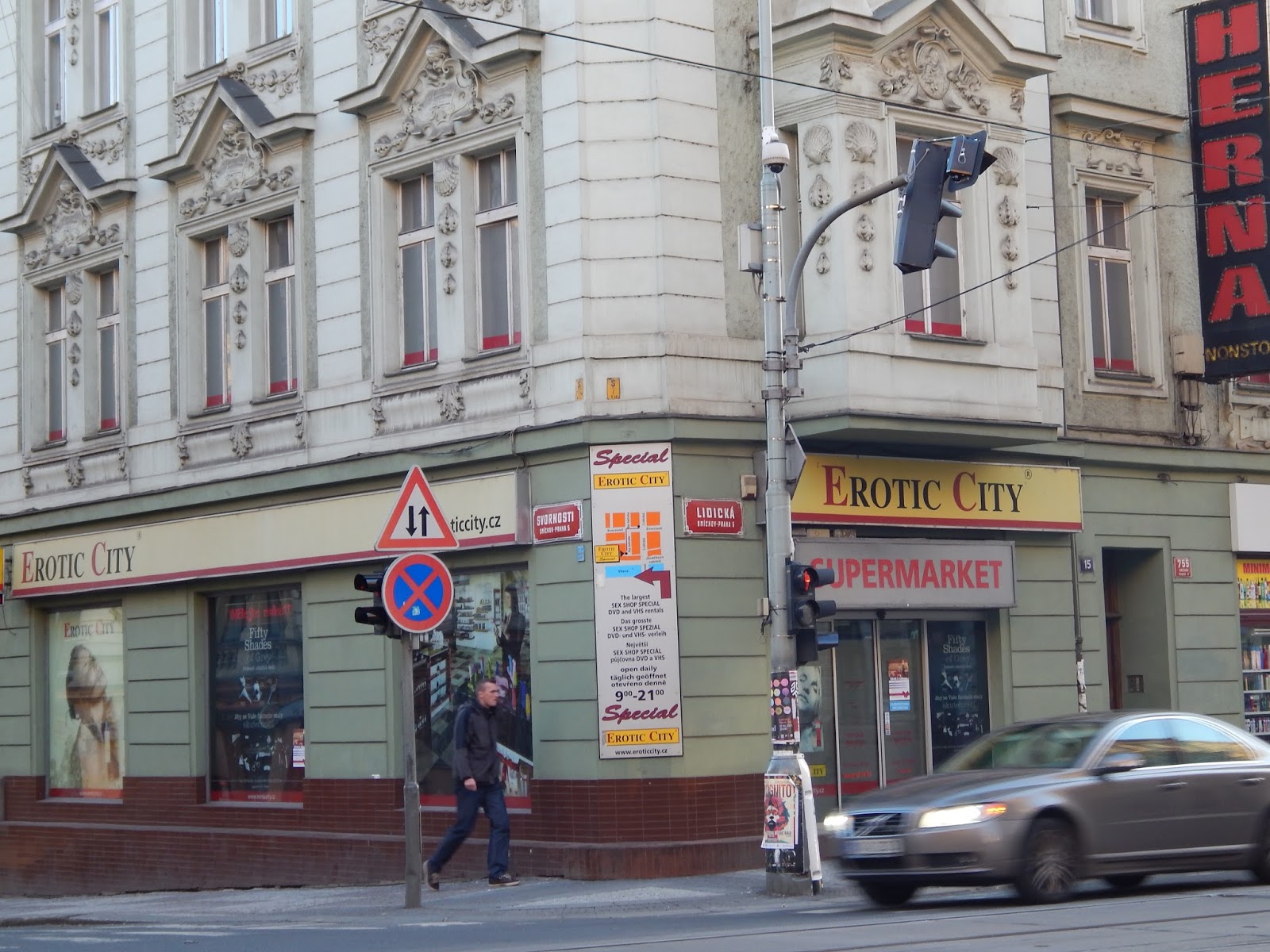
Erotic Supermarkets, 'Night Gyms' and the Butcher of Prague


Having both been to Prague before we were excited to re-discover the beautifully preserved Staré Město, spared by the uprising in May 1945 that avoided Prague becoming a battle site like so many other European cities .  The old town offers a beautiful stroll through its eclectic architectural styles, winding streets and numerous bridges that span the Vltava River.  As strange gargoyles hang from the roof tops and beautiful frescos adorn the renaissance style buildings it is impossible not to become captivated with the city.    Rather than entering the castle and museums we therefore spent our few days in Prague on a couple of walking tours, making the most of the autumn sunshine and learning about the often gloomy history of the city.
 
In need of breakfast having arrived late into the city Hannah set off for the supermarket opposite to get some butter and eggs. She returned slightly flushed having visited (the not so subtle) ‘Erotic City’ Supermarket which only stocked a different kind of lubricant and eggs .  We headed off into Prague on our standard free walking tour, learning about general Czech history and getting our bearings in an often confusing city.  Our guide was very charismatic and talked us through the major sites in Prague; from the Old Town Square with the iconic Astrological Clock through to the Jewish quarter of the city (as well as the fantastically named 'Night Gym' complete with red lights and lewd sign).  The tour lasted for around 3 and a half hours and so we were happy to be able to recharge our battery’s and drink hot wine to keep us going for the duration.  The majority of our time was spent leaning about the old town square and some of the stories behind the statues and symbols dotted about the area.  One of the largest statues in the square depicts a Czech hero, Jan Hus, the former dean of the Charles University who played a major role in changing religion in Europe.   It was interesting to learn that a hundred years before the Protestant Reformation was started by Martin Luther, Jan Hus was burnt as a heretic for reformist ideas in the old town square.  We also enjoyed discovering what all of the different dials on the Astrological clock actually do, from showing the “Babylonian Time” to pointing out the name to be celebrated on each day of the year in Czechoslovakia.  We then walked back to our accommodation via the Charles Bridge and past the John Lennon wall (it used to be daubed with political messages and beetles lyrics following his assassination despite the best attempts of the secret police to stop it) that still provides people (mainly crusty hippies strumming on guitars and handing out flowers) with an opportunity to graffiti the wall with peace symbols and messages.


The John Lennon Wall


On the second day we spent the morning roaming the hill above Prague before walking through the now scarlet and gold wood to the Prague Castle complex.   The views from the walk were well worth the climb to the top and we were able to look out across the Charles Bridge into the old town as well as seeing the new sprawling city beyond.  We then headed to the Powder Tower to go on a tour of Prague that highlighted the city during WW2.  The tour described the terror of the Nazi occupation and we explored the last hideout of the Prague resistance beneath the city.  The tour explained how the city was saved by the resistance as the Nazi’s in Prague agreed to leave with no more fighting and surrender to the Americans across the demarcation line, rather than surrender to the advancing red army.  Sadly the leader of the resistance and German army both ended up serving a prison sentence in the cellars under the city during the Soviet occupation with the German receiving better treatment and a more lenient sentence than a national hero deemed to be a threat to communism.  The guide was very knowledgeable and finished by describing in detail the assassination of the highest ranking Nazi to be killed during the war, Reinhard Heydrich (the architect of the final solution to the Jewish question).  Although the tour was a sobering end to our time in Prague it was a good way to learn about Heydrich as we headed off to Krakow to visit Auschwitz and Schindler's Factory.